

What is personalization?
Personalization means adapting content, offers, and messaging to the individual customer. It builds on what a company knows about that customer, such as their behavior, purchase history, or the channel they arrive through. The goal is that every customer finds what they need faster. The company benefits because more visitors buy and customers come back.
In a store, this is a given. Every good salesperson does it. Online, it only happens when you build it on purpose. The example further down shows what that looks like in practice.
Two related terms are often confused. With individualization, the customer adapts something themselves, for example a sneaker in a configurator. With personalization, the company adapts the experience, usually without the customer noticing.
An example: the same car, two customers
Imagine you're standing in a car dealership and have to sell an Audi Q7. The spec sheet says 2,976 cc of displacement, 286 PS (282 hp), 6.9 liters of diesel per 100 kilometers, 4.82 meters in length, and a new-car price from €79,675. The same spec sheet applies to every customer.
The first customer hands you his card: Arthur von Greven Jr., junior boss. He speaks in a refined way, seems very well informed, and knows exactly what he wants. Status matters to him, and he's interested in new technology. In the language of the Limbic® Types, he is a Performer.
Next comes the Junkerhagen family: Martin, Britta, and Niklas. The father's handshake is soft. He keeps looking at his wife, talks about “us,” and raves about vacations at the house by the lake. Security matters to him. He is a Harmonizer.
A good salesperson translates the same facts into two different benefit promises:
Fact from the spec sheet | For the Performer | For the Harmonizer |
|---|---|---|
Raised seating position | “A lofty driving feel thanks to the raised seating position.” | “Safety thanks to the raised seating position and the solid build.” |
286 PS (282 hp) | “The richest sound we have.” | “Safe passing, plenty of reserves.” |
Latest technology | “You can even read your emails while driving.” | “More economical than other models, thanks to the start-stop system.” |
4.82 meters in length | “You'll draw every eye with this one.” | “Plenty of room for the whole family, for trips and vacations.” |
Comparison and confirmation | “You'll leave an ML in the dust in no time.” | “I sold one to a nice family just like yours only yesterday.” |
The same car, two customer types: facts from the spec sheet and how each type is pitched.
Online, it works the same way, just without a salesperson. On the product page, the Performer first sees performance, technology, and exclusivity, for example. The Harmonizer sees the same page with safety features, space, and fuel consumption on the first screen, plus an image with a family and luggage. The price, the product, and the facts stay the same. Only the order, the image, and the argument change.
How the website recognizes who it is dealing with is covered further down, under the characteristics and in the section on purchase motive.
Why personalization is becoming a competitive factor
Most companies treat personalization as a conversion measure. Its greater value lies elsewhere. Three developments are making it a competitive factor and, in the long run, a question of survival.
The direct path to the customer is getting narrower. In many shops, only around 20% of visitors arrive directly on the homepage, and those are almost all existing customers. The rest come through search engines, comparison portals, marketplaces, and campaigns. Now AI assistants and shopping agents are joining in. They want to control the traffic themselves, and more and more often an agent does the choosing, no longer a person in front of your homepage. If you still want to be chosen directly, you have to be anchored in customers' minds beforehand. Part of today's campaign budgets already goes toward winning back customers the company actually knew.
The brand is built at every touchpoint. For customers, the customer experience is the brand, and not only in the shop. It is built just as much at delivery, in a question to customer service, or in a complaint. There it often has even more impact, because the customer has a problem at that moment and is paying close attention. A company that shows at each of these points that it knows its customer comes across as more competent and stays in mind long before the next search begins. Friction works in the opposite direction and quietly weakens the relationship, contact by contact. That is why personalization in the long run leads beyond the website to omnichannel personalization, which includes all channels.
Discounts and media are getting more expensive. Acquisition costs are rising, and margins can't carry any more discounts. Many companies still put most of their budget into new customers, although existing customers generate a large share of revenue. As assortments converge, price is all that's left without a recognizable difference. Relevance is the lever that costs neither margin nor additional media budget. A competitor can undercut your price tomorrow. What your customers want and where they dropped off, he cannot copy.
Customers expect this, too. According to McKinsey, 71% of consumers expect personalized content, and 78% would buy again thanks to personalization. According to the same study, companies that master personalization generate on average 40% more revenue from it than the average company.
So personalization is more than an uplift in the next quarter. It helps decide whether a company keeps direct contact with its customers or hands it over to platforms and agents. Whoever loses this contact competes on price alone. In the long run, the companies that stay relevant to their customers survive.
It doesn't always pay off, though. Personalization only brings something once customers actually differ in their behavior. If all visitors buy for the same reasons, one good page for everyone is enough. How to check this is covered further down, under measurement.
What you can personalize
Personalization can start from many characteristics. The most common ones:
Characteristic | Example |
|---|---|
Channel and campaign | Visitors who arrive through the ad “cheap electricity” first see the best-price guarantee |
Behavior on the website | Visitors who have visited a category three times in 30 days see it at the top of the homepage |
Purchase history | Visitors who have bought expensive products so far get a different style of imagery and copy |
Customer type and purchase motive | The security-oriented visitor sees guarantees, the status-oriented visitor sees new arrivals |
Status | New customers get messaging that makes it easier to get started, returning customers see their latest purchases |
Device and location | Mobile visitors see shorter paths, visitors near a store see availability at the store |
External factors | Weather or season determine which products appear at the top |
What personalization can start from, with one example each.
Every channel and every point of the customer journey can be personalized. The better question is where it pays off. The next two sections show that.
Personalization along the customer journey
What a customer needs depends on where they currently stand. Someone who doesn't yet know they have a problem needs something different from someone who is already comparing two products. Good personalization therefore also follows the phase of the journey.
Phase | What the customer thinks | What personalization can do |
|---|---|---|
Unaware | “I don't really need anything.” | Inspiration that fits interests and season, without sales pressure |
Problem Aware | “I have a problem and I'm looking for solutions.” | Guides and onboarding help on the identified topic |
Solution Aware | “I know there are solutions.” | Comparisons, filters by need, arguments that fit the purchase motive |
Product Aware | “I've found the right product.” | Reassurance in the cart: guarantees, delivery time, availability in the store |
Most Aware | “I'm a satisfied customer.” | Repeat purchases, accessories, benefits for returning customers, referrals |
What personalization can do in each phase of the customer journey.
The most common mistake in this logic is showing every visitor discounts, no matter where they stand. The first-time visitor feels pressured, and the returning customer would have bought without a discount anyway.
Personalization by channel
Each channel delivers different signals and calls for different measures. Here are the most important ones, with examples from tests of what works there and where it tips over.
Website and shop: pick up where the customer left off
The shop usually holds the biggest lever, because most contacts happen here and every reaction is measurable. Almost all shops already have the strongest signal: a visitor comes back with a product in the cart.
In a test from our experiment database, the mini cart opened for these returning visitors on the first page view, with a short note. No new data or new tool was needed. The conversion rate per visit rose by 20.01%, and customers needed 17.50% fewer visits before buying. One side effect was interesting: product page views rose by 51.10%. Customers were double-checking their decision. That is exactly where the next step pays off, with delivery time, returns, and reviews instead of new sales arguments.
In another test, the same audience got an overlay with entry points to matching categories. The result was a drop of 14.76% in the main goal, and the test was stopped. The drop was driven by visitors who had landed directly on a product page through an ad and suddenly were shown something else. The rule from both tests: picking up where the customer left off works, redirecting costs.
For visitors who aren't logged in, behavior during the current visit counts. At computeruniverse, a model recognizes the customer type even before login. More on this in the example further down.
Campaigns and entry channel: the source reveals the motive
A shop knows where a visitor comes from before the first click. Still, most visitors see the same homepage, whether they arrive from a search ad with a firm intent to buy or hear about the offer for the first time through a banner. According to industry benchmarks, Google Ads search campaigns convert at 7.5% on average, display advertising at 0.9%. Anyone who shows both the same page gives away this difference.
Three examples show what this looks like in practice. At e.on, customer types such as the skeptic, the bargain hunter, and the exclusive buyer were distinguished. Someone searching for “cheap electricity” lands on a page that starts with the best-price guarantee, while the skeptic first sees seals and trust elements. At a telecommunications provider, landline prospects saw an offer related to their city on the very first page, long before they entered an address. The add-to-cart rate rose by 2.3%. And at computeruniverse, the conversion rate of visitors from Google Shopping rose significantly when the messaging matched their purchase intent.
The same test also shows the limit. A best-price award that worked well with other sources brought no advantage with visitors from price comparison portals. People who have already compared prices in detail find such a seal pushy. Every source needs its own argument, and that can only be tested source by source.
Email and CRM: occasion instead of calendar
Most newsletters follow the editorial calendar. Emails that respond to an occasion are more effective: an interrupted purchase, a first purchase that calls for a follow-up recommendation, or a customer who hasn't been around for a long time. Content, timing, and frequency can be steered by purchase history and behavior.
The connection to the shop is decisive. If an email addresses the customer with a product and the click leads to a generic homepage, the effect is lost. The landing page should continue the message of the email, ideally with the same product and the same argument.
App: the best signal, if it's used
In the app, users are usually logged in. That means wish lists, recent purchases, sizes, and preferences are available directly, without a model having to guess. Many apps still show the same homepage as the website. Obvious entry points are the recently viewed products, the right size as a default, and notes on products from the wish list that are back in stock or reduced.
Store, customer service, and delivery: where the brand has the strongest impact
This is where it is decided whether personalization works across channels. Anyone who started something online shouldn't have to start over in the store or on the phone. A service agent who sees which product the customer looked at online yesterday can advise in a targeted way. Someone who sees in the shop that their product is available at the nearest store is more likely to buy than someone who has to guess.
What it looks like without this connection is shown by a journey from customer interviews at a mobile network provider. The customer had poor reception, too little data volume, and a move ahead of her. The provider had all of this information. All that reached her was a text message “Data volume used up.” A suitable offer never came, and she canceled.
The 4S model: the four maturity levels of personalization
In over 50 personalization projects, we have seen the same maturity levels again and again. Out of that came our 4S maturity model, with the stages Start, Stabilize, Scale, and Sustain. On the left are quick, simple measures. Moving right, effort, customer value, and ROI rise up to self-learning, cross-channel personalization.
Why is it important to know your own stage? Because each stage needs different data, different roles, and different tools. Anyone who doesn't know this makes one of two expensive mistakes.
The first mistake is starting too high. A company at stage 1 buys a platform for stage 4 because the vendor promises AI and 1:1 messaging. Then the data, the segments, and the people who develop use cases are missing. The expensive tool becomes an excuse not to start at all. The second mistake is staying at the bottom. The first quick wins run, then nothing follows, and nobody notices that the company has hit a plateau.
The stage also determines what you can prove. At stage 1, the effect of individual measures often can't be demonstrated yet. From stage 3, uplifts are regularly proven against control groups, and only then can personalization be justified as an investment to executive management and controlling. Anyone who knows their stage therefore plans the next step instead of the one after that, and knows what budget is needed for what.
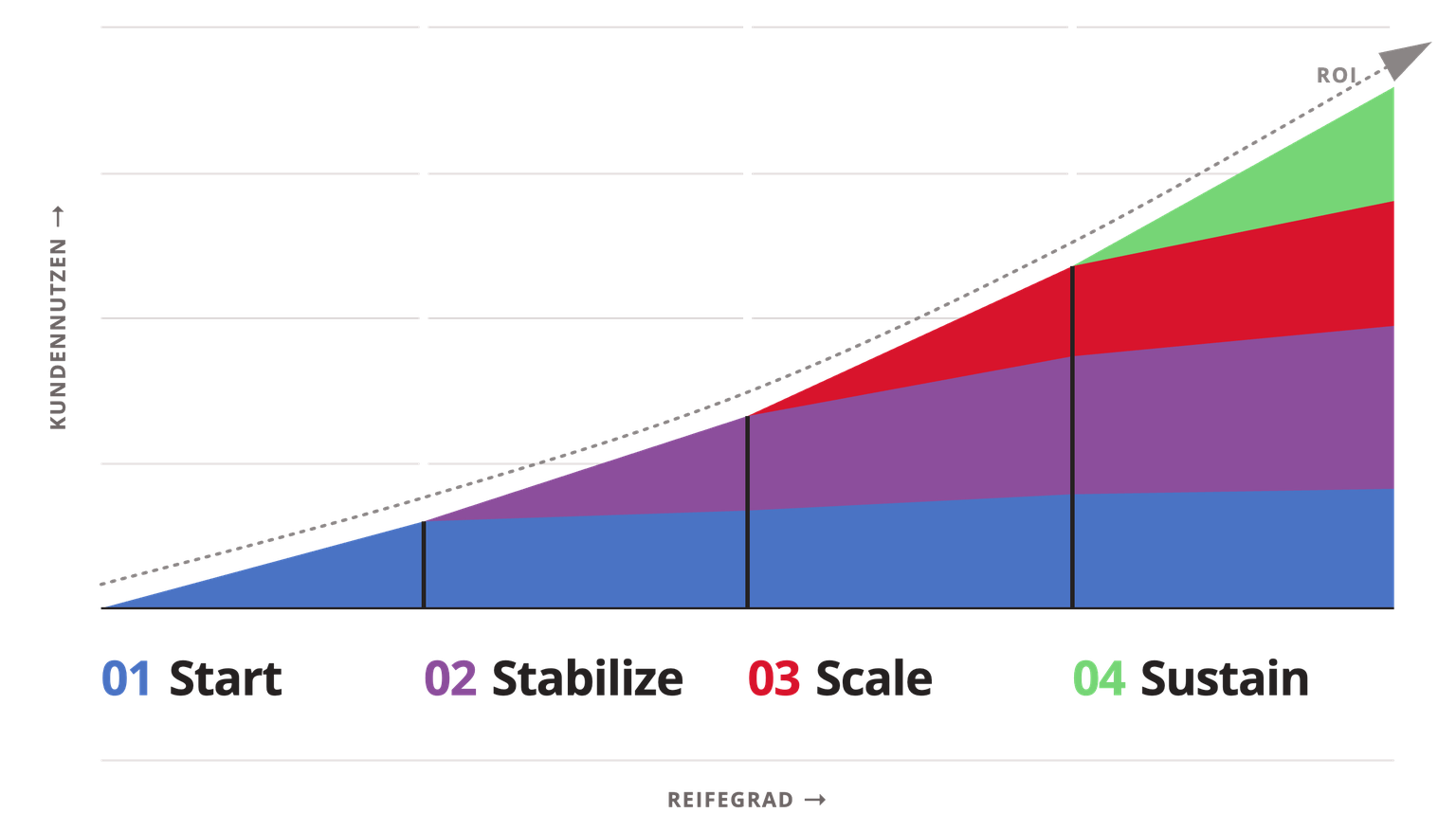
konversionsKRAFT's 4S model of personalization: customer value and ROI rise with each maturity level.
Stage | What happens | Example |
|---|---|---|
1 Start | First quick wins with simple rules, live within hours. The effect of individual measures often can't be proven yet | Fitting messaging for new and returning customers, for example a welcome that matches the entry channel, or messaging based on affinity for a category |
2 Stabilize | Rules and metrics: customer needs are linked to data, and the rules are still hypotheses | The customer type “Performer,” derived from purchase history, gets different images and copy |
3 Scale | Data instead of manual work: a model assigns visitors automatically, and uplifts are proven against control groups | Psychographic instead of demographic segments: recommendations and arguments by recognized customer type, for example by Limbic® Types |
4 Sustain | The model keeps learning. Data science and AI steer messaging 1:1 and across all channels | Even visitors without a history get fitting content |
The 4S model: the four maturity levels of personalization.
The hardest step is from stage 2, Stabilize, to stage 3, Scale. It only succeeds when someone brings together data, customer understanding, and implementation.
Working customer-first: simpler, with a higher hit rate
The most important decision in personalization is made before the first use case. Anyone who starts with the customer instead of data and technology makes the whole effort simpler and significantly raises the chance that it works.
Most personalization projects start with data. Segments are built from whatever web analytics provides, and only then does someone think about what to show them. The result is segments like “mobile visitors from Bavaria,” dozens of conceivable use cases, and measures that don't really help anyone. Each of them has to be built, tested, and maintained.
The reverse path is shorter. First you ask why people buy from you and what holds them back. A customer who seeks security needs different arguments than one who seeks status, even if both buy the same product. Only then do you look for the data that reveals these motives.
That simplifies things in three places:
Fewer segments: Instead of dozens of data segments, you're left with a few customer types that really differ. At computeruniverse, there were five.
Fewer use cases: One or two clear measures follow from each motive, instead of a long list of ideas.
Less data: You look specifically for the signals that reveal a motive, instead of collecting everything that's possible.
And it raises the hit rate. A measure that comes from an understood motive already has a rationale before the test. At freenet, around two thirds of tests were successful because every hypothesis came from customer understanding. The same holds for personalization, because every personalized variant is a test against a control group.
There are proven tools for this:
Customer interviews and Jobs to Be Done: What does the customer want to get done at this moment, what drives them, what holds them back?
Neuropsychological customer types: Models like the Limbic® Types describe which motives guide people.
Personas from data: Qualitative customer types are linked with transaction data and thereby become measurable.
Segment psychographically, not demographically
Most segments describe who someone is: age, gender, place of residence, device. That says little about why they buy. Two 45-year-old men from Munich can tick completely differently. One wants the newest thing and likes to show it off, the other mostly wants to avoid mistakes. A demographic segmentation treats both the same.
Psychographic segmentation starts with the motive. The Limbic® Types of Nymphenburg Group divide customers by the emotional systems that steer their decisions, such as Performers, Harmonizers, or Traditionalists. From that it follows directly which images, arguments, and products someone should see. The car example above shows this on a small scale. konversionsKRAFT is the only licensed partner of Nymphenburg Group in the digital field.
This pays off especially for three reasons. One customer type steers many measures at once, from imagery to the order of arguments to recommendations. It stays stable over time, while device or entry channel change with every visit. And a few types are enough, so the number of variants stays small.
We have worked this way for a long time. One of our first public cases dates from 2010, from the street fashion retailer Frontlineshop. In interviews with the target group, we first identified the motives behind buying sneakers. That produced three variants of the same product detail page, one for each emotional system of the Limbic® Map:
Balance: a clean, tidy presentation of the sneaker
Stimulance: sneaker and wearer both in the picture, rebellion and individuality in the foreground
Dominance: darkened background, targeted lighting, status and exclusivity in the foreground
In the A/B test, all three variants beat the previous page. The Dominance variant stood out most, with +79% cart views. Product and price stayed the same. Only the motive the page speaks to changed.
Back then this wasn't personalization yet, but a classic A/B test with one variant for everyone. The result did lead us to the decisive idea, though. If every variant wins, there is no single winner. There are different customer groups that respond to different motives. Anyone who shows everyone the winning variant gives away the uplift of the others. Today a model recognizes the customer type automatically and serves each visitor their variant, as at computeruniverse.
Personalization examples with results
computeruniverse: +18.2% revenue per visitor
The online retailer for electronics has more than 100,000 products. Many visitors only log in during checkout, so for a long time the shop doesn't know who is browsing. We first developed qualitative customer types and linked them with transaction data. That produced a scoring with almost 200 data points. Today the system recognizes the customer type before login and adapts recommendations and arguments in the cart.
Measured against a control group, this brought +18.2% revenue per visitor and +23.8% more logins before checkout. Recommendations matched to the customer type landed in the cart 8.63% more often. To the computeruniverse case study
hessnatur: first results after four weeks
At the fashion retailer hessnatur, the aim was a fast, provable start. From setting up the tool to the first three personalized experiences, four weeks passed. The campaigns brought +12% revenue per visitor with brand-related benefits and +9% with product recommendations. That is the step from Start to Stabilize in the 4S model and shows that personalization doesn't have to be a multi-year project.
ALDI SÜD: one strategy for all digital channels
ALDI SÜD had data, audience knowledge, and individual personalization activities in several channels. But every channel had its own goals and its own maturity level. Together, we selected three customer segments per channel, developed use cases from the needs behind them, and prioritized them by business value, feasibility, and data situation. In the end, every channel had a roadmap with measures that can be implemented with the existing infrastructure. To the ALDI SÜD case study
C&A: developing personalization as a team
At C&A, personalizations emerge in workshops where audience, content, and implementation are thought through together. Worthwhile segments are either small with an above-average conversion rate or basket size, or large with below-average values. Every campaign is measured against a control group.
Three more test examples: a model selection by need with +23% leads, a product page with +10.18% conversion rate, and a fashion retailer with up to +14.31% revenue.
How to proceed: personalization in 5 steps
Most process models start with data and technology. We start with the customer. The order sounds like a detail but changes everything that follows. Anyone who first understands why people buy needs fewer segments, fewer use cases, and less data. And every measure has a rationale before the test, which is why more tests win.
1. Understand customers
Before you talk about data or tools, you clarify why your customers buy and what holds them back. Customer interviews, Jobs to Be Done, and the Limbic® Types are suited for this. A segment analysis of past A/B tests also shows where customers respond differently. In the end, you have a clear picture of the drivers and brakes of each important customer group. At Frontlineshop, these were the motives behind buying sneakers, at computeruniverse five customer types. This leads to the most important test question for everything that follows. Personalization only has a positive effect if it solves a customer problem better than the page for everyone. An adaptation that only shows that you have data helps nobody.
2. Define a few customer types
From these motives, you form a few customer types that really differ and matter for your business. Three to five are usually enough. Only now do you ask which signals reveal them: entry channel, searched category, purchase history, behavior on the page. So you look specifically for the data that reveals a motive, instead of collecting everything that's possible.
3. Check potential and prerequisites
Calculate beforehand where personalization pays off. Look at traffic, conversions, and possible uplifts per customer type and customer journey. From that you get how many tests you can run there and which ROI is realistic. The required sample size and the traffic per customer type give you the test duration for each use case. At the same time, check what your technology can already deliver today and who in the company is responsible. Without clear ownership, the best ideas get lost between marketing, IT, and e-commerce.
4. Derive use cases from the motives
For each customer type, one or two clear measures follow from its drivers and brakes. The Performer first sees performance and exclusivity, the Harmonizer safety and service. Rate the measures by business value, feasibility, and data situation. Begin with what the existing infrastructure can already do.
5. Test, evaluate, roll out
Every personalization is a hypothesis first. Test it against a control group, roll out what works, and learn from what doesn't. Because every hypothesis comes from customer understanding, the hit rate is higher than with ideas from the data pool. That way personalization grows stage by stage, and every step is proven.
How to measure whether personalization works
This is the point where most guides stay silent. Personalization almost always feels right. Whether it brings revenue is shown only by the comparison with a group that doesn't see it.
Two levels have proven their worth:
Local control group per campaign: One part of the segment sees the personalized variant, the other doesn't. This works like an A/B test. One primary metric is measured, such as revenue per visitor, conversion rate, or basket size.
Global control group: A small share of all visitors permanently gets no personalization at all. Only this way do you see what all campaigns bring together, and whether they interfere with each other.
A good way in is to evaluate existing A/B tests by segment. If a variant shows a strong effect among price-conscious visitors and none among others, you have a candidate for personalization. Two rules apply. Plan the run time at least twice as long, because individual segments are smaller than the total traffic. And define the segments beforehand. Anyone who searches after the test until segment no. 27 is significant finds chance instead of insight.
A calculation example shows why this matters. Suppose a segment makes up 20% of your traffic. A test that takes three weeks for all visitors would need about five times as long for this segment alone. For very small segments, a clean proof is therefore hardly possible. That is a good reason to start with a few segments that are large enough. The example is simplified and assumes the same conversion rate in the segment.
At computeruniverse, the minimum requirements were 95% confidence, more than 3,500 conversions per variant, and a run time of more than one full business cycle. To check whether a result is reliable, run a significance test at your chosen confidence level.
Common personalization mistakes
Most personalization projects don't fail because of technology. They fail because of assumptions nobody questions at the start. We see these mistakes in projects again and again, sorted by the point where they arise.
Mistakes in strategy
1. Personalizing because everyone does. “Personalization is important, so let's do it too.” That is how many initiatives begin. There is a vision, but no connection to a company goal and no metric that shows success. Without a goal, there is no prioritization, and in the end there are many small measures without measurable impact. Personalization is a tool for reaching a goal, such as more repeat purchases or fewer abandonments.
2. Personalizing without solving a customer problem. An adaptation that only shows you have data achieves nothing. Personalization only has a positive effect if it makes something easier for the customer than the page for everyone.
3. Starting too big. Anyone who wants real-time 1:1 personalization across all channels right away spends the first year on data projects and has not yet earned a single euro of additional revenue. Often the line is: “First we have to build the infrastructure and the segments.” That sounds thorough but delays the start by months. Better are a few use cases that run on existing technology and quickly show what personalization brings.
4. Stopping after the quick wins. The first quick wins run, then nothing follows. The plateau usually arises because customer understanding, process, and ownership are missing. The step from Stabilize to Scale in the 4S model needs a different way of working than the start.
Mistakes in approach
5. Starting with the tool. The software is bought, but nobody knows what it should deliver. Often the first ideas then come from the tool vendor itself. At a travel provider, all the first personalization tests came from such suggestions, and none of them worked. One test, for example, showed visitors exactly the trips they had decided against shortly before. Another distracted from the actual offer on the product detail page.
6. Starting with the data. Segments are built from what the data allows and then sit in the testing tool. The next question is: “What do we do with them now?” Nobody knows which segment is relevant and which need lies behind it. In our projects, this is the most common starting point, and it makes everything after it harder. The reverse path is described above, in the section on the customer-first approach.
7. Segments without a difference. If segments don't behave differently, separate messaging achieves nothing. Age, gender, or device are easy to collect but say little about the purchase motive. A segment analysis of past A/B tests quickly shows whether there are any differences at all.
8. Copying best practices. “What works for the competition works for us, too.” That is rarely true. Without your own understanding of your own customers, the effect doesn't materialize or lasts only briefly.
Mistakes in execution
9. Too little change. Nobody notices a different image in a banner. If personalization doesn't noticeably move the customer forward, the effect stays within the measurement noise.
10. Too much change. The same person uses a phone, a laptop, and the app and sees something different each time. That confuses and leads to abandonment. On top of that comes the question of how much knowledge a customer wants to see. What is meant helpfully quickly feels intrusive. Effective personalization sits in the middle corridor.
11. Underestimating the effort. “Personalization scales along on its own.” It doesn't. Every segment needs its own variants, its own content, and its own tests in every channel. With five segments, three channels, and two variants, that quickly makes 30 pieces of content to maintain. Without a process, mainly the workload grows. That is another reason why a few customer types pay off more than many data segments.
Mistakes in organization and measurement
12. Personalization as a separate project next to testing. “Personalization is different from optimization, so we need our own project for it.” That creates duplicate structures, and the learnings from A/B tests and personalization end up in separate teams. Yet every personalization is a test, and many good personalization ideas come from the segment analysis of A/B tests.
13. Handing responsibility to one team. “Team XY is responsible for personalization.” But personalization needs data, content, technology, and customer understanding at the same time. If it sits in a silo, the translation between disciplines is missing. Every channel pursues its own goals, the pace slows down, and the impact stays invisible.
14. Not measuring, or measuring wrongly. Without a control group, nobody knows whether personalization brings revenue or only effort. Measurement errors are just as harmful: tests with too little traffic, stopped too early, or evaluated incorrectly. Then the verdict is “no uplift” although the measure would have worked, and the project loses its backing.
15. Not sharing results. Successes stay within the team, failures go unmentioned. That builds no backing in the company, and nobody learns from tests that didn't win. Those often show most clearly what customers don't want.
Who in the company is responsible
Personalization touches almost every department. Marketing knows the campaigns, CRM the existing customers, BI and data science the data, IT the systems, and the e-commerce team the shop. Good ideas rarely fail because of technology. They fail because nobody decides.
A small core team with clear responsibility has proven its worth. At C&A, audiences and personalization sit with the UX team. Other companies assign them to the conversion team. What matters is less where the team sits than that it has access to all three areas: data, customer experience, and implementation. At the beginning, a structured questionnaire to everyone involved helps, so that goals, data, and responsibilities are on the table.
Data and privacy
Personalization needs data, but less than many think. Most companies have more data than they use. Start with what is there: purchase history, behavior in the shop, channel, and campaign. Don't collect more than you need for a specific use case.
For tracking and profiling, you generally need your visitors' consent. Clarify the details with your data protection officer before a use case goes live.
One point is often underestimated. Many people reject tracking in general and still want the convenience it enables. Acceptance rises when the personalization offers a recognizable benefit. Anyone who uses data to genuinely help customers has less explaining to do than someone who only wants to sell more.
Tool, agency, or do it yourself?
There are many good tools for personalization. But they only solve the delivery. They don't answer the questions that come before: which motives your customers have, which segments are worthwhile, which use cases come first, and how you prove the impact.
| Tool only | Build in-house | With a partner |
|---|---|---|---|
Strength | technically ready quickly | knowledge stays in the company | experience from many projects, faster to the first proven result |
Risk | tool without use cases, plateau after the quick wins | takes time, needs analytics, UX, data, and development | dependency if no knowledge transfers to the team |
Fits when | customer understanding and a testing culture already exist | a dedicated team with all roles exists | you want to show impact quickly and build structures |
Tool, in-house setup, or partner compared.
We work tool-independently. We bring customer understanding, test strategy, and our own implementation, and work with the tool you have or the one that fits you. What that looks like in practice, from the first test to the program, is on our personalization page.